
Saffron can be categorized and classified from various perspectives:
Iranian Cultural Terms
| Kashmiri Cultural Terms
| Spanish Cultural Terms
| Italian Cultural Terms
| Moroccan Cultural Terms
| Arabic Cultural Terms
|
Market Terminology
| Market Price
| ISO 3632 Standards
| Color Strength
| Medal Rating
| Saffron family charaters
|
virginity | Physicochemical Properties
| Visual color Appearance
|
|
|
|
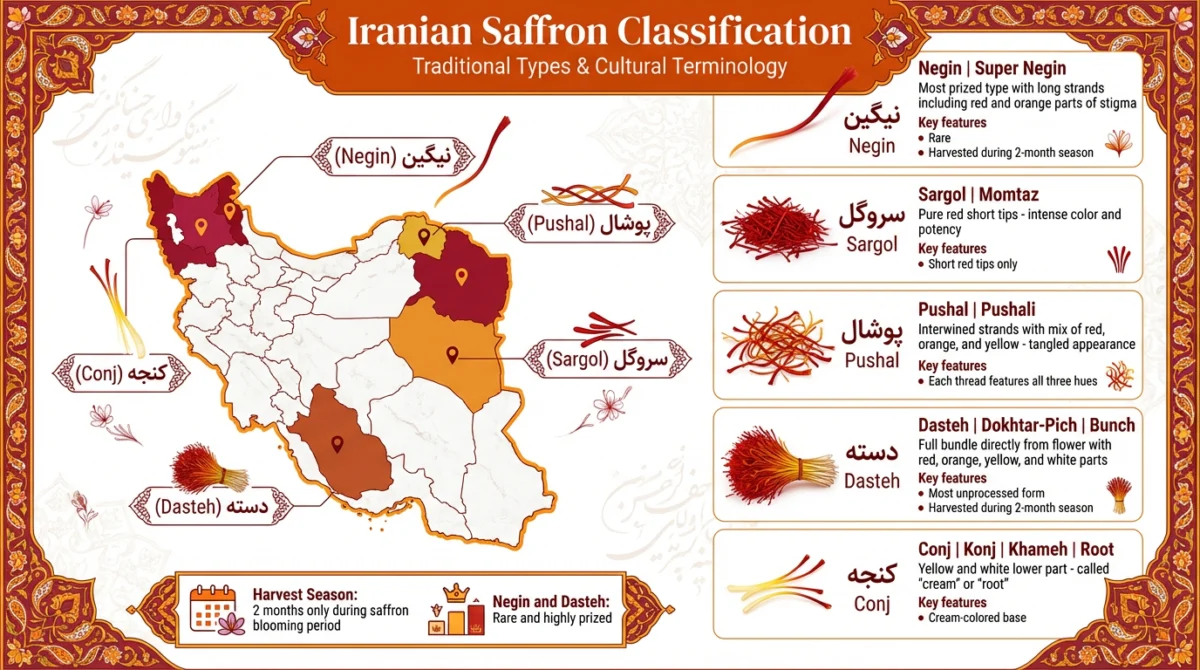
Iranian Cultural Terms
Iran is the heartland of saffron, and the most authoritative terminology for saffron types comes from Iranian culture, which classifies saffron into five main categories:
- Negin | Super Negin: Negin is the most prized type of saffron, known for its long strands that include the red and orange parts of the stigma. This type is rare and can only be harvested during the saffron blooming season, which lasts about two months.
- Sargol | Momtaz: Pure red! Sargol refers to the short, red tips of the saffron strands, known for their intense color and potency.
- Pushal | Pushali: These are interwined strands that include a mix of red, orange, and yellow colors, with each thread featuring all three hues. It’s named for its tangled appearance.
- Dasteh | Dokhtar-Pich | Bunch: A full bundle of saffron strands, directly taken from the flower, containing red, orange, yellow, and white parts. Dokhtar-Pich is the most unprocessed form of saffron, incorporating all its components. Like Negin, Dokhtar-Pich can only be harvested during the two-month saffron season.
- Conj | Konj | Khameh | Root: The yellow and white lower part of the saffron strand is called Conj, also known as the “root” or “cream.”
Market Terminology
In the saffron market, particularly in customs and trade contexts, the following terms are commonly used to describe different types of saffron:
- All Red, Coupe, or Cut Filament: These refer to Sargol, the short red tips of the saffron strands.
- Negin or Premium All Red: This refers to the longer saffron strands that include both red and orange sections.
- Pushal: This type includes strands with a mix of red, orange, and yellow. Pushal with less yellow is sometimes called “La Mancha,” while Pushal with more yellow is known as “Rio.” It’s also referred to as “Sierra.”
- Style: This term is used for the white or cream-colored part of the saffron strand.
Based on Virginity or Unprocessing
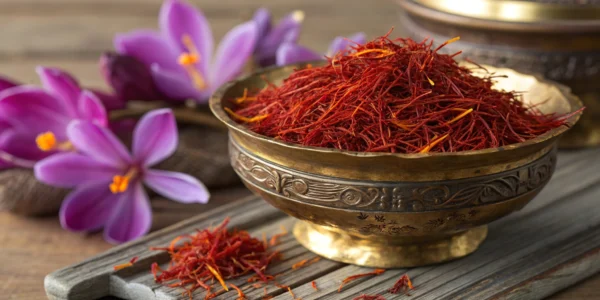
Consumers often prefer products that are as close to their natural state as possible. In saffron production, the strands are usually divided into smaller sections to create different types. The highest level of intactness is found in the Dasteh, or Dokhtar-Pich, variety, where the strands are taken directly from the flower and bundled together without any cutting. If these intact strands are cut at various points, different types of saffron are produced. When categorizing saffron by intactness, the following hierarchy emerges:
- Dasteh (Dokhtar-Pich): This type is harvested directly from the flower without any cutting, maintaining its complete form.
- Negin and Pushal: If the saffron strand is cut from the red part down to the orange section, you get Negin. If it’s cut from the red part down to the yellow section, you get Pushal. Both have the same level of intactness.
- Sargol: Sargol is created by further cutting Pushal, which involves more processing, making it the least intact form of saffron.
Based on Market Price
Saffron is significantly more expensive than other spices. The high cost of this “red gold” is due to the labor-intensive process of cultivating, harvesting, and producing it. The price of saffron is determined by the value of each type:
- Negin: Negin is the most valuable type of saffron, featuring long strands that include both the red and orange parts.
- Sargol: Sargol is the pure red portion of the saffron strand, prized for its intense color.
- Pushal with Less Yellow: This type of Pushal has strands with minimal yellow.
- Pushal with More Yellow: This type contains strands with a greater amount of yellow.
- Dasteh: Dasteh is a full bundle of saffron strands, including all parts from red to white.
Wholesale Saffron Price August 2024 | ||
Type of Saffron | Kilogram – AED | Kilogram – USD |
Super Negin | 6,500 | 1,850,000 |
Negin | 6,400 | 1,750,000 |
Sargol | 6,150 | 1,700 |
Pushali | 5,700 | 1,600 |
Dasteh | 4,600 | 1,300 |
Conj | 590 | 165 |
Based on ISO 3632
The International Organization for Standardization (ISO) has assigned code 3632 to saffron. ISO 3632 provides the standard guidelines for testing saffron quality, including metrics for color, aroma, taste, and other factors.
Key criteria for measuring saffron quality according to ISO 3632 are:
- Color: Crocin measures saffron’s color, with a numerical index below 220. The highest crocin absorption occurs at a wavelength of 440 nanometers.
- Aroma: Safranal measures the aroma, with values ranging from 20 to 50. The highest absorption of safranal is found below 330 nanometers.
- Taste: Picrocrocin assesses the taste, with a standard value of 70. The highest picrocrocin absorption is below 257 nanometers.
- Moisture Content
- Contamination
- Size and Shape
- Transparency
Saffron is classified under ISO 3632 standards as follows:
- Cut Filament – Sargol: The short red tips of saffron, derived from Pushal.
- Grade 1 Filament – Negin: The long strands of saffron with both red and orange parts.
- Grade 2 Filament – Pushal: Includes strands with red, orange, and a bit of yellow.
- Grade 3 Filament – Regular Pushal: Contains strands with red, orange, and more yellow.
- Grade 4 Filament – Dokhtar-Pich or Dasteh: A complete strand with red, orange, yellow, and white parts.
Iso 3632 | ||||
Saffron grade | Color Strength Crocin | Taste Strength Picrocrocin | Aroma Strength Safranal | Moisture |
Cut Filament – Sargol | ≤220 | ≤85 | 20-50 | 10 |
Grade 1 Filament – Negin | ≤200 | ≤80 | 20-50 | 10 |
Grade 2 Filament – Pushal | ≤180 | ≤70 | 20-50 | 12 |
Grade 3 Filament – Regular Pushal | ≤150 | ≤70 | 20-50 | 12 |
Grade 4 Filament – Dokhtar-Pich or Dasteh | ≤140 | ≤70 | 20-50 | 12 |
Based on Visual Color Appearance
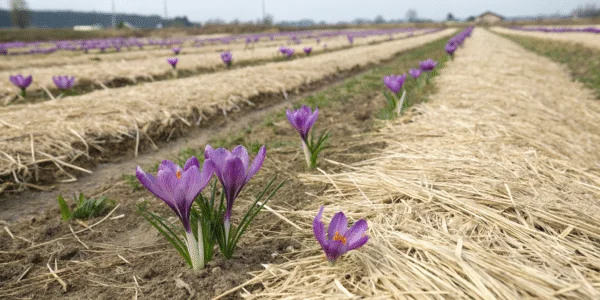
Saffron is sometimes classified by its color strength. Since saffron strands contain four colors—red, orange, yellow, and white—different types of saffron have varying levels of color strength depending on the proportions of these colors and the amount of crocin.
Crocin is a natural carotenoid found in saffron as well as in other flowers like crocus and gardenia. It is a diester formed from a dicarboxylic acid called crocetin, with each end bonded to a disaccharide known as gentiobiose.
Crocin appears as deep red crystals with a melting point of 186°C. It is soluble in water, creating an orange solution. This compound is mainly responsible for saffron’s color. Studies have also demonstrated that crocin has antioxidant properties, anticancer effects, and antidepressant qualities.
In the saffron market, saffron types are classified by their color strength in the following order:
- Sargol
- Negin
- Pushal with Less Yellow
- Pushal with More Yellow (referred to as “Mancha” in Spanish)
- Dasteh
The minimum color strength standard for saffron according to ISO 3632 | |||
Iranian Saffron | Spanish Saffron | ||
Negin | <200 | Coupe | <190 |
Sargol | <220 | Lamancha | 180-190 |
Pushal | <180 | Rio | 150-180 |
Dasteh | <150 | Standard | 110-150 |
Conj | <100 | Sierra | <110 |
Based on Medal Classification
Sometimes saffron is classified based on medals such as diamond, gold, silver, and bronze. This system, developed by the creative team at Netasaf, is especially used in the market, particularly in Iran. In this classification, each term is represented by the first letter:
- Negin: N
- Sargol: S
- Pushal: P
- Dasteh: D
- Conj: C
Additionally:
- Diamond: D
- Gold: G
- Silver: S
- Bronze: B
Thus, each of the five types of saffron (Negin, Sargol, Pushal, Dasteh, and Conj) is further classified into four quality grades: Diamond, Gold, Silver, and Bronze.
Based on the Saffron Family
When we become familiar with the saffron plant, understand its parts, and know their names, we can recognize the saffron family. The creative team behind the All Red saffron brand has named the members of this family and presented them in an engaging animated series aimed at raising awareness, particularly among children. According to this classification, the saffron family members are:
- Mr. Corm (Saffron Corm): The father of the family.
- Mrs. Flower (Saffron Flower): The mother of the family.
- DokhtarPich (Saffron Bunch): The main child of the family (complete and intact or virgin).
- Negin (Red and Orange Parts of the Saffron Stigma): The tall and stylish daughter of the family.
- Pushal (Red, Orange, and Yellow Parts of the Saffron Stigma): The messy son of the family, appearing disheveled due to its moisture.
- Sargol (Short Red Part of Pushal): The youngest grandchild of the family, and the child of Pushal. Though the smallest, it is the most colorful and contains the highest crocin content.
Based on Physicochemical Properties
Saffron can also be classified based on its physical and chemical characteristics.
Physical Classification:
- Visual color Appearance
- Straightness of Strands
- Width of Strands
- Length of Strands
- Freezing Damage
- Rain Damage
- Roundness of Tips
- Colored Roots
- Bundling
Chemical Classification:
- Color Quality (Crocin)
- Taste Quality (Picrocrocin)
- Aroma Quality (Safranal)
Safron Grade | Color Strength Crocin | Taste Strength Picrocrocin | Aroma Strength Safranal | Moisture |
1 | ≤220 | ≤85 | 20-50 | 10 |
2 | ≤200 | ≤80 | 20-50 | 10 |
3 | ≤180 | ≤70 | 20-50 | 12 |
Based on Kashmiri Tradition
Kashmir, as one of the major saffron-producing regions, classifies saffron types as follows:
- Mongra: Sargol – Only the short red parts of the saffron strands.
- Lachha: Dasteh – Includes red, orange, yellow, and white parts.
- Zarda: The cream or root – Yellow and white parts.
- Broken Mongra: Broken Sargol.
Based on Spanish Tradition
Spain, after Iran, exports some of the highest-quality saffron in the world. It is also important to note that Spain imports a significant amount of saffron from Iran and the UAE. Spanish saffron is classified into the following categories:
- Coupe: The highest quality and most expensive Spanish saffron, consisting only of the red and orange parts.
- Mancha: This is equivalent to Grade 1 Pushal, containing red, orange, and a bit of yellow.
- Rio: Considered an economical saffron, it is Grade 2 Pushal, including red, orange, and a larger amount of yellow.
Based on Moroccan Tradition
Morocco is the most significant saffron-producing country in Africa. Moroccan saffron is categorized into four grades:
- Grade 1: Long and wide saffron strands with red and orange parts, equivalent to Iranian Negin saffron.
- Grade 2: Saffron that contains the red parts of the strands, equivalent to Sargol.
- Grade 3: Dasteh or Bundle saffron, where complete saffron strands are gathered into a bundle.
- Grade 4: Lower quality saffron used for bulk purposes.
Based on Italian Tradition
In Europe, Italy ranks second after Spain in saffron production and export. Italian saffron varieties include:
- Dell’aquila: Saffron from the city of Aquila, known for its long, red strands, equivalent to Iranian Super Negin saffron.
- Di Sardegna: Grown on the island of Sardinia, this saffron features red strands and can be equivalent to Iranian Negin saffron.
- Toscano: Red and short saffron, similar to Iranian Sargol.
- Dell’Umbria: Also similar to Iranian Sargol.
Based on Arabic Tradition
In Arab countries, especially the UAE, Oman, Kuwait, and Saudi Arabia, saffron is considered a strategic commodity and is widely used. According to Arabs, saffron is classified into the following categories:
- Grade 1 Super Negin (الدرجة الأولى زعفران سوبر نقيل): High-quality saffron with long strands (about 3 cm) and red and orange colors.
- Grade 2 Abu Shal (الدرجة الثانية زعفران أبو شال): Pushal saffron, containing red, orange, and yellow parts.
- Grade 3 Abu Shayba (الدرجة الثالثة زعفران أبو شيبة): Dasteh or Bundle saffron, which includes complete saffron strands with red, orange, yellow, and white colors.
Based on Appearance Color
This classification is a creative approach by the NetaSaff team, which categorizes saffron based on its appearance color:
- Red (Sargol): Saffron that consists only of the red part of the strands. It is short in length and derived from Pushal saffron.
- Red-Orange (Negin): Saffron that includes all the red parts of the strands plus the orange parts. It is long in length and considered high quality.
- Red-Orange-Yellow (Pushal): Saffron that is intertwined and includes the yellow part of the strands.
- Red-Orange-Yellow-White (Dasteh): Complete saffron strands that come directly from the flower, including all four colors.
- White (Conj): The white parts of saffron, cut from the yellow part of the strands, also known as cream or style.