
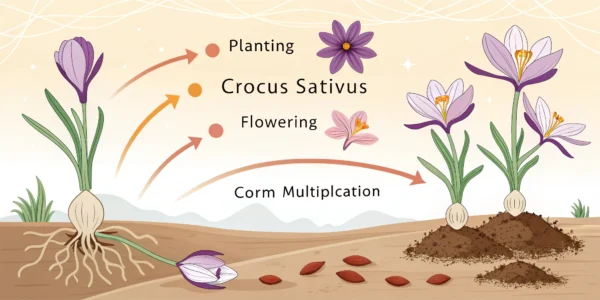
The Crocus sativus plant (the scientific name for saffron) belongs to the iris family and is a bulbous plant. Saffron corms are capable of propagation, which is why over the years, saffron fields become saturated with new corms. But is there a relationship between the weight of saffron corms and their flowering potential? The answer is yes. Corms are categorized into three groups: small, medium, and large. The weight and strength of saffron corms are key factors, and most farmers prefer medium-sized corms for planting.
Mayada’s Discussion on Saffron Corm Size and Quality
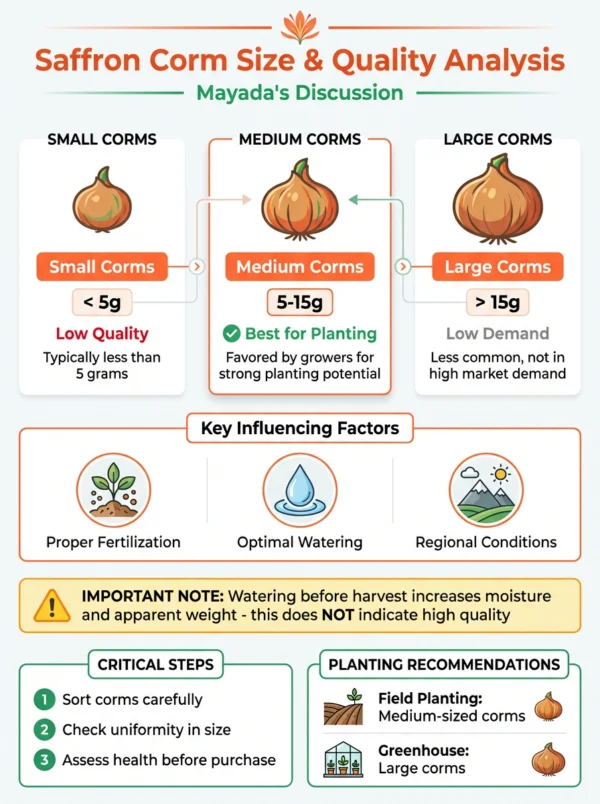
- Small saffron corms typically weigh less than 5 grams and are considered low quality.
- Medium-sized corms weigh between 5 and 15 grams and are favored by growers due to their strong planting potential.
- Large corms, weighing over 15 grams, are less common and generally not in demand in the market.
- The size and quality of a corm are directly affected by its nutrition and vitality. Proper fertilization and watering, adapted to regional climate conditions, are essential.
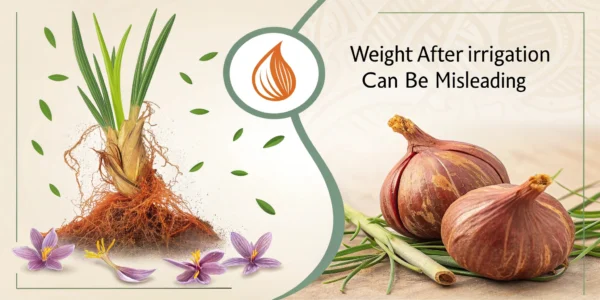
- Watering the field before harvesting can increase the moisture and apparent weight of the corms, leading inexperienced growers to mistakenly consider them high quality.
- Sorting saffron corms is crucial; uniformity in size and health should be checked before purchase.
- For field planting, medium-sized corms are the most suitable option.
- For greenhouse saffron cultivation, large corms are preferred due to their robustness.
Saffron Corm Weight and Planting Suitability Table
| Corm Type | Corm Weight | Planting Suitability |
|---|---|---|
| Small | 5 grams or less | Not suitable |
| Medium | 5 – 15 grams | Ideal for soil-based cultivation |
| Large | Over 15 grams | Best for greenhouse cultivation |